Spartadex lockdrop: 2023 lock periods and exit rules
Spartadex lockdrop rewarded liquidity commitments on Arbitrum One during its July and August 2023 launch event. Phase 1 offered locks of 2 to 52 weeks. Phase 2 accepted SPARTA, USDC.e, or both, with different withdrawal rules for each token. Those entry windows have ended.
The short version: The 2023 Phase 2 rules allowed temporary USDC.e withdrawals, while committed SPARTA had no equivalent exit during the contribution window.
V2 pool eligibility and the tokens entering the lock
Phase 1 accepted liquidity pool (LP) tokens from eligible SushiSwap and Camelot pools on Arbitrum One, with support limited to V2 positions. An LP token represented a share of pooled assets. Participants first supplied the pair assets to the originating exchange, then committed the resulting LP tokens to the lockdrop.
The eligible pairs included WETH/ARB, USDC.e/USDT, WETH/USDC.e, GSWIFT/USDC.e, and WBTC/WETH. GSWIFT/USDC.e qualified through SushiSwap only; the event did not support that pair through Camelot. USDC.e was the stablecoin named in the participation terms. Matching a pair's abbreviated display name alone did not establish eligibility. The originating exchange, network, and V2 pool format also mattered. When adding liquidity, participants supplied equal values of the pair assets, rather than necessarily equal token quantities.
From wallet approval to a recorded commitment
The Phase 1 locking form required an LP token quantity, an originating exchange, and a chosen lock period before participants confirmed the commitment. Its wallet flow separated permission to spend LP tokens from the transaction locking them. An approval authorized spending; it did not itself establish a completed lock. The subsequent confirmation concerned the lockdrop transaction.
The interface then displayed committed positions in its locked-liquidity summary, grouped by pair and exchange. That summary distinguished a position recorded in the event from LP tokens merely held in a wallet. Participants selected the quantity manually, through a slider, or with the Max control. Committing less than the full LP balance left the unselected tokens outside the lock.
Lock length and the declining entry bonus
Phase 1 offered lock periods of 2 to 52 weeks during the 2023 event. Participants chose the duration alongside the amount of LP tokens. Longer commitments increased SPARTA rewards under the event's design, while also extending the period during which the selected liquidity remained committed. The duration described the liquidity obligation, separate from when reward tokens became available.
Entry timing supplied another reward input. The early-contribution boost started at 15% on the first day and declined linearly to zero by the end of Phase 1. A stated lock duration alone could not establish a participant's final SPARTA allocation. The value committed, the relevant pool allocation, and the entry boost also affected the reward.
The July 28 cutoff preceded the end of Phase 1
Phase 1 allowed early withdrawals until July 28, 2023, at 15:59 UTC, although the contribution phase continued until July 30 at 15:59 UTC. Contributions could therefore remain open after the early exit route closed. The date the entry phase ended did not cancel the longer lock period a participant had selected.
The early withdrawal control allowed a participant to select an LP quantity to remove, including a partial withdrawal. Removing liquidity affected the associated opportunity to receive SPARTA rewards. The interface warned about that consequence before withdrawal.
Separate SPARTA allocations for each liquidity pool
Phase 1 assigned separate SPARTA reward budgets to the eligible pairs, so a position's pool determined which allocation applied. The published distribution was:
- WETH/ARB: 1,500,000 SPARTA.
- USDC.e/USDT: 1,500,000 SPARTA.
- WETH/USDC.e: 1,500,000 SPARTA.
- GSWIFT/USDC.e: 750,000 SPARTA, restricted to SushiSwap liquidity.
- WBTC/WETH: 750,000 SPARTA.
These budgets totaled 6,000,000 SPARTA for Phase 1. Each budget covered a particular pool's participants. The distribution rewarded eligible contributions within that pool, accounting for their value and lock terms. LP token quantities, asset values, and SPARTA reward quantities represented different units.
Phase 2 committed SPARTA and USDC.e to a new pool
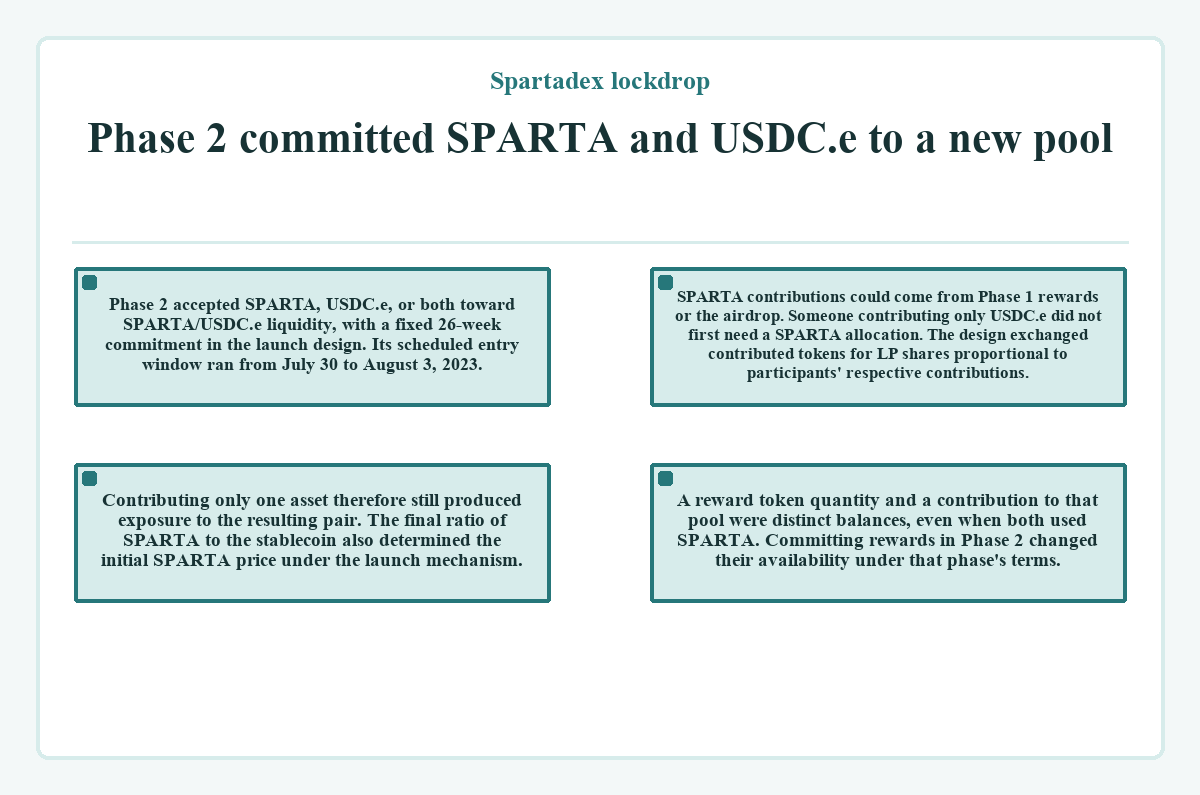
Phase 2 accepted SPARTA, USDC.e, or both toward SPARTA/USDC.e liquidity, with a fixed 26-week commitment in the launch design. Its scheduled entry window ran from July 30 to August 3, 2023. SPARTA contributions could come from Phase 1 rewards or the airdrop. Someone contributing only USDC.e did not first need a SPARTA allocation.
The design exchanged contributed tokens for LP shares proportional to participants' respective contributions. Contributing only one asset therefore still produced exposure to the resulting pair. The final ratio of SPARTA to the stablecoin also determined the initial SPARTA price under the launch mechanism. A reward token quantity and a contribution to that pool were distinct balances, even when both used SPARTA. Committing rewards in Phase 2 changed their availability under that phase's terms.
Could Phase 2 participants withdraw SPARTA and USDC.e on the same terms?
Phase 2 gave USDC.e a temporary withdrawal route, while SPARTA contributions had no equivalent withdrawal option during its contribution window. Phase 2 permitted USDC.e withdrawals until August 1, 2023, at 15:59 UTC. That cutoff arrived before the scheduled end of Phase 2. The interface called the USDC.e action Withdraw. After the USDC.e cutoff, the early withdrawal route closed for that asset too. These rules governed the launch contribution window. They did not describe the separate SPARTA single-asset staking cooldown, which belonged to another mechanism.
A partial withdrawal before the Phase 2 deadline
For a hypothetical comparison, assume commitments of 1,264 USDC.e and 1,264 SPARTA before the Phase 2 USDC.e cutoff, with 314 tokens selected for withdrawal from either balance.
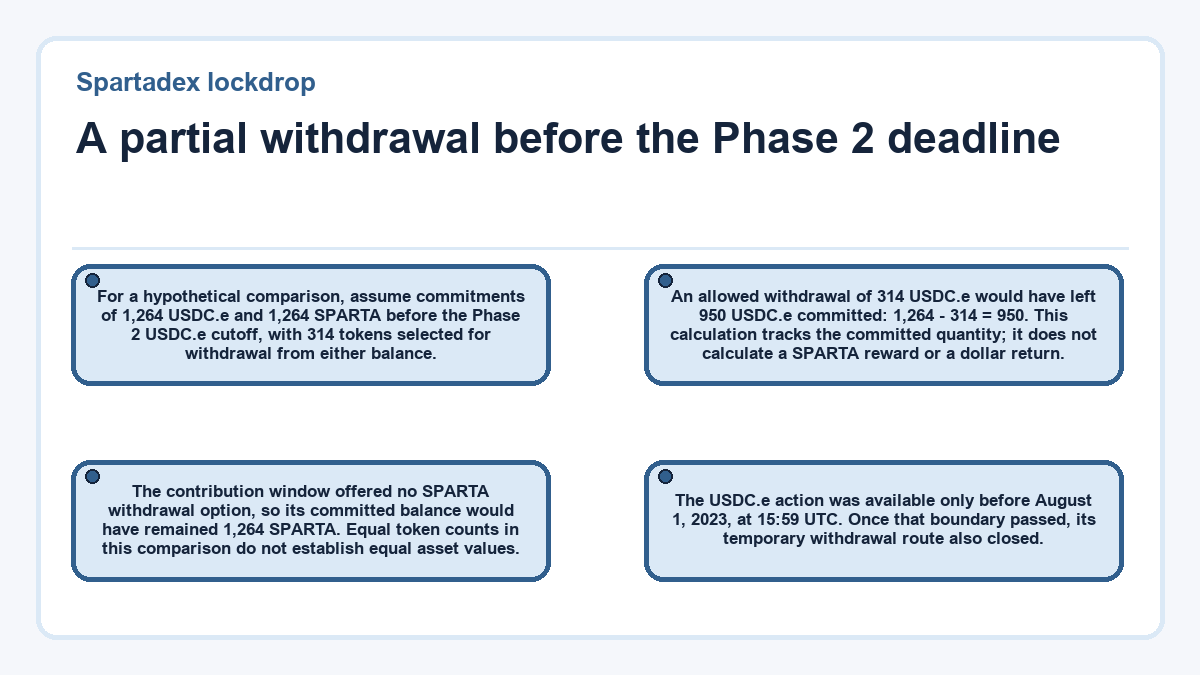
An allowed withdrawal of 314 USDC.e would have left 950 USDC.e committed: 1,264 - 314 = 950. This calculation tracks the committed quantity; it does not calculate a SPARTA reward or a dollar return.
The contribution window offered no SPARTA withdrawal option, so its committed balance would have remained 1,264 SPARTA. Equal token counts in this comparison do not establish equal asset values.
The USDC.e action was available only before August 1, 2023, at 15:59 UTC. Once that boundary passed, its temporary withdrawal route also closed.
Reward vesting followed a different timetable
Phase 1 scheduled half of its SPARTA rewards for the token generation event (TGE), with the remaining half vesting linearly over six months.
The vesting schedule applied to the SPARTA reward allocation, not to the entire value of the liquidity a participant committed. A 50% reward release therefore did not mean half the LP position became withdrawable. Likewise, choosing a longer liquidity lock did not turn the six-month reward schedule into the same duration as that lock.
Phase 2 had a separate budget of 1,000,000 SPARTA, split equally between SPARTA and USDC.e contributors. The full reward allocation was scheduled for availability at TGE. The launch schedule placed TGE on August 3, 2023. That date described planned token availability, distinct from the maturity of committed liquidity. Individual claims remained separate from scheduled availability.
Subsequent ecosystem rewards used their own claim and staking rules; the lockdrop's release percentages did not define every later SPARTA distribution.
The 2024 Linea option preserved eligible lock durations
The March 26, 2024 expansion announcement offered a Linea migration option for Phase 1 participants with 40-week or 52-week locks, preserving their lock duration. The announced participation window ran from March 27 at 18:00 UTC to April 3 at 18:00 UTC. Those dates concerned the later migration opportunity, separate from the 2023 lockdrop entry and withdrawal windows.
Participation followed a first-come, first-served process with pair-specific caps intended to retain liquidity on Arbitrum. The plan also included conversion into SPARTA/USDC, with conversion choices varying by pair. Conversion changed the underlying assets as part of the migration. The announcement offered that opportunity to eligible positions without reporting a completed migration for every participant. Its March and April dates did not reopen the original early withdrawal windows.
Lockdrop commitments and ordinary LP staking
The launch design called for migrating Phase 1 liquidity into Spartadex pools after the event. It described redeeming the originating LP tokens into their underlying assets to create the destination liquidity. LP token counts across exchanges could consequently differ without the count alone measuring a gain or loss.
Selected pools also offered ecosystem rewards for LP staking. Those pool rewards differed from the launch allocation, and their existence did not erase a lockdrop commitment. Under the historical terms, participants could claim Phase 1 LP tokens after the chosen lock expired; Phase 2 LP tokens unlocked after 26 weeks. Current access for claiming or withdrawing a 2023 position remains unconfirmed. Historically, the lockdrop exchanged a defined liquidity commitment for launch rewards, while ordinary LP staking rewarded eligible pool participation under its own terms.
Spartadex lockdrop: what people ask
Why were staked SushiSwap or Camelot LP tokens missing from the Phase 1 window?
The 2023 interface did not display eligible LP tokens while participants had them staked on SushiSwap or Camelot. Participation required unstaking those LP tokens before committing them to the lockdrop. That prerequisite concerned the existing LP stake at the originating exchange, separate from the new lockdrop commitment and its selected duration.
Could Uniswap liquidity enter Phase 1 directly?
The 2023 lockdrop did not support direct migration from Uniswap. Its participation route required removing that liquidity and supplying an eligible V2 pair through SushiSwap or Camelot before committing the resulting LP tokens. The same pair name on another exchange did not make its position compatible. GSWIFT/USDC.e remained restricted to SushiSwap.
Was it possible to prepare liquidity before the lockdrop opened?
Participants could prepare eligible liquidity directly through SushiSwap or Camelot before the July 24, 2023 opening. The lockdrop's Provide button became available only after the event started. Preparing the originating pool position did not itself commit its LP tokens to the launch event; that commitment required the separate lockdrop transaction.
How did the Phase 1 price slider differ from a SPARTA reward quantity?
The Phase 1 interface labeled its SPARTA price slider as a prediction, separate from the quantity of reward tokens. A predicted token price did not establish an executed sale price or a fixed dollar return. The displayed liquidity, reward quantity, and predicted price described different measures, even when the interface presented them together.
Could one wallet commit positions from several pools and exchanges?
A participant could commit multiple eligible pair positions from the supported exchanges during Phase 1. The interface separated locked liquidity by pair and exchange. Each position still needed eligible LP tokens and a selected lock period. Showing several positions together did not combine their separate pool reward budgets into one unrestricted allocation.
Did locked liquidity count toward Polis game progression?
The historical game rules counted lockdrop assets as locked LP for mainnet game progression. Developing a Polis required those assets to exceed $100 in value, and their value affected experience gain. That recognition concerned game eligibility; it did not cancel the liquidity commitment or make the locked assets available for withdrawal.
Which pair-specific restrictions applied to the 2024 Linea migration?
The announced migration option for eligible 40-week and 52-week Phase 1 locks treated two pairs differently. GSWIFT/USDC.e allowed migration without conversion. WETH/ARB required full conversion into SPARTA/USDC when migrating. Other eligible pairs had partial-conversion controls, subject to their caps. Conversion changed the underlying pair, while migration preserved the original lock duration.