Spartadex Senate levels and SpartaPad allocation requirements
Spartadex linked SpartaPad IDO allocation boosts to Senate levels in its historical launchpad design. Level 20 provided a $25 first-come, first-served (FCFS) allocation; levels 30, 40, and 50 added boosts of 20%, 35%, and 50%, respectively. Separate SPARTA staking tiers governed sale-round access. Current sale availability and continued use of these parameters remain unconfirmed.
An initial decentralized exchange offering (IDO) offered project tokens through a launchpad sale. Senate progress affected the allocation benefit, while staked SPARTA established a participation tier. Liquidity and city development supported the Senate level; they were separate from the tokens committed to single-asset staking.
Senate milestones for SpartaPad allocations
Level 20 established the first listed Senate allocation benefit: $25 in the FCFS round. Higher milestones paired that amount with a percentage increase in IDO allocation. These parameters belonged to the historical Gamified Launchpad design.
| IDO allocation benefit | Senate level required |
|---|---|
| $25 FCFS allocation | Level 20 |
| 20% allocation boost plus $25 FCFS allocation | Level 30 |
| 35% allocation boost plus $25 FCFS allocation | Level 40 |
| 50% allocation boost plus $25 FCFS allocation | Level 50 |
| Staking tiers listed sale-round access separately from these Senate bonuses. | |
The historical schedule assigned a 50% IDO allocation boost to Senate level 50. The accompanying dollar allocation concerned the FCFS round, while the percentage described an increase relative to the participant's IDO allocation.
How did SPARTA staking affect sale-round access?
The SPARTA staking tiers specified sale-round access for their holders, with distinct token thresholds for each published tier. These requirements concerned staked token quantities, independent of their changing market price.
The FCFS-only entries were Recruit at 3,000 SPARTA, Hoplite at 6,000 SPARTA, and Spartan at 10,000 SPARTA. Those tiers gave access to the first-come, first-served round, where larger allocations remained subject to the round's ordering principle.
The tier description listed Hero at 15,000 SPARTA, Aristocrat at 25,000 SPARTA, and GOD at 50,000 SPARTA. All three entries listed access to guaranteed and FCFS rounds. The document gave conflicting minimums for guaranteed allocation: 15,000 and 25,000 staked SPARTA.
Allocation size also depended on the staked amount within the tier system.
Liquidity and Polis experience before Senate upgrades
Game progression required eligible liquidity alongside a Polis non-fungible token (NFT), the city asset used by the strategy game. The liquidity rules specified a $100 minimum for upgrading the city, while ongoing experience gain depended on liquidity value in whitelisted pools. Lockdrop balances also counted toward the mainnet game's liquidity requirement when their value exceeded $100. That condition concerned locked liquidity, distinct from an uncommitted SPARTA wallet balance. In the March 4, 2024 deployment description, Arbitrum One hosted the game and exchange.
What had to happen before the Senate could level up?
A Senate upgrade required enough experience points and other buildings at least at the same level as the Senate. The progression schedule listed cumulative experience totals, separate from the tokens staked for launchpad eligibility. Level 20 required 52,900 experience points; level 50 required 647,900.
Building levels supplied another constraint. Experience alone did not satisfy the upgrade rule if the rest of the city lagged behind, and upgrades also used resources and gems. Higher liquidity brackets generated experience faster, while successful battles against Barbarians could add a small amount. Experience rate and building development both affected progress toward the next Senate milestone.
The $25 allocation described purchasing capacity
$25 in FCFS allocation described purchase capacity in a token sale, not a cash distribution to a wallet. At later Senate milestones, the schedule listed that fixed amount beside a percentage boost to IDO allocation. A percentage uplift alone did not establish a token quantity or purchase payment; those amounts required the applicable sale's base allocation and price terms. The listed $25 FCFS amount did not, by itself, establish the base allocation for the percentage calculation.
Allocation boosts and gamified LP yield used different measures
The liquidity provider (LP) staking design tied Senate progress to a separate reward model called Gamified Yield. Its annual percentage rate (APR) figures concerned yield on staked liquidity positions, while the SpartaPad percentages concerned sale allocations. In the March 4, 2024 Long Term Incentives Pilot Program (LTIPP) application, the team said the Senate yield boost remained under development.
Reward staking could contribute to the qualifying balance
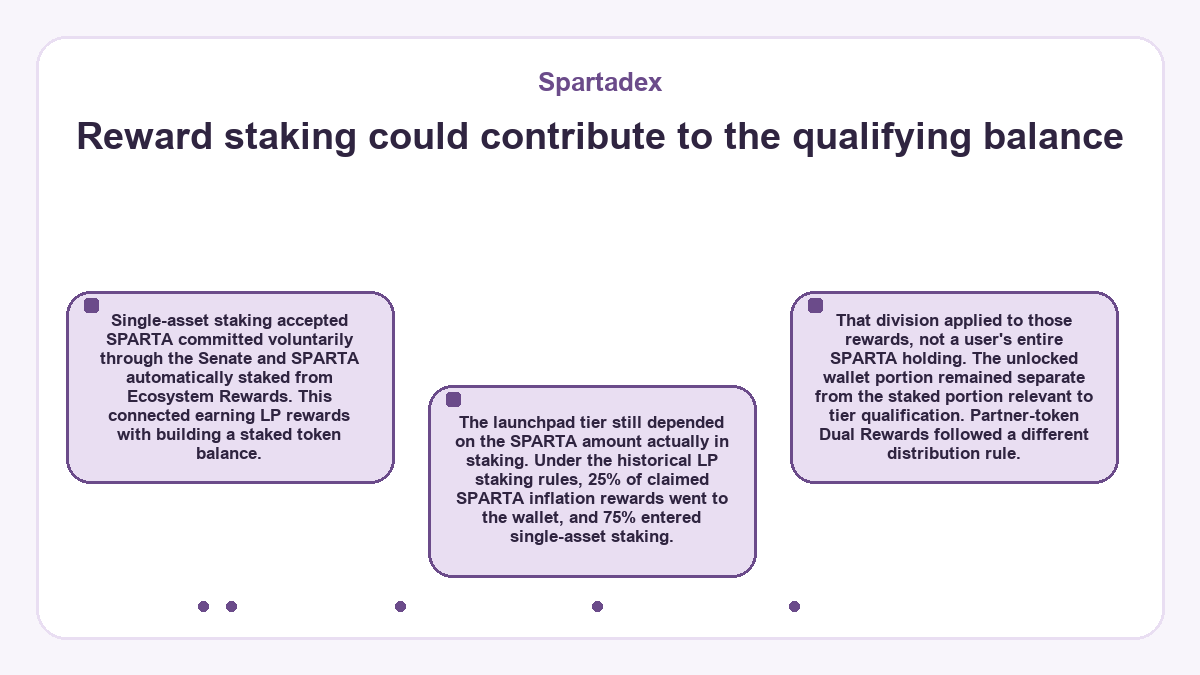
Single-asset staking accepted SPARTA committed voluntarily through the Senate and SPARTA automatically staked from Ecosystem Rewards. This connected earning LP rewards with building a staked token balance. The launchpad tier still depended on the SPARTA amount actually in staking.
Under the historical LP staking rules, 25% of claimed SPARTA inflation rewards went to the wallet, and 75% entered single-asset staking. That division applied to those rewards, not a user's entire SPARTA holding. The unlocked wallet portion remained separate from the staked portion relevant to tier qualification. Partner-token Dual Rewards followed a different distribution rule.
Cooldowns and claim charges affected committed SPARTA
A ten-day cooldown carried a 50% fee in the historical single-asset SPARTA unstaking schedule. A 110-day cooldown allowed withdrawal without commission. The fee fell by 0.5 percentage points for each additional cooldown day between those endpoints. These figures concerned releasing staked SPARTA, separate from the IDO allocation bonus. Reward claims in the Senate carried a separate fixed charge of 0.0005 ETH. Those fee rates did not specify how a particular sale treated SPARTA in an active cooldown.
The GOD tier added a fundraising-based airdrop
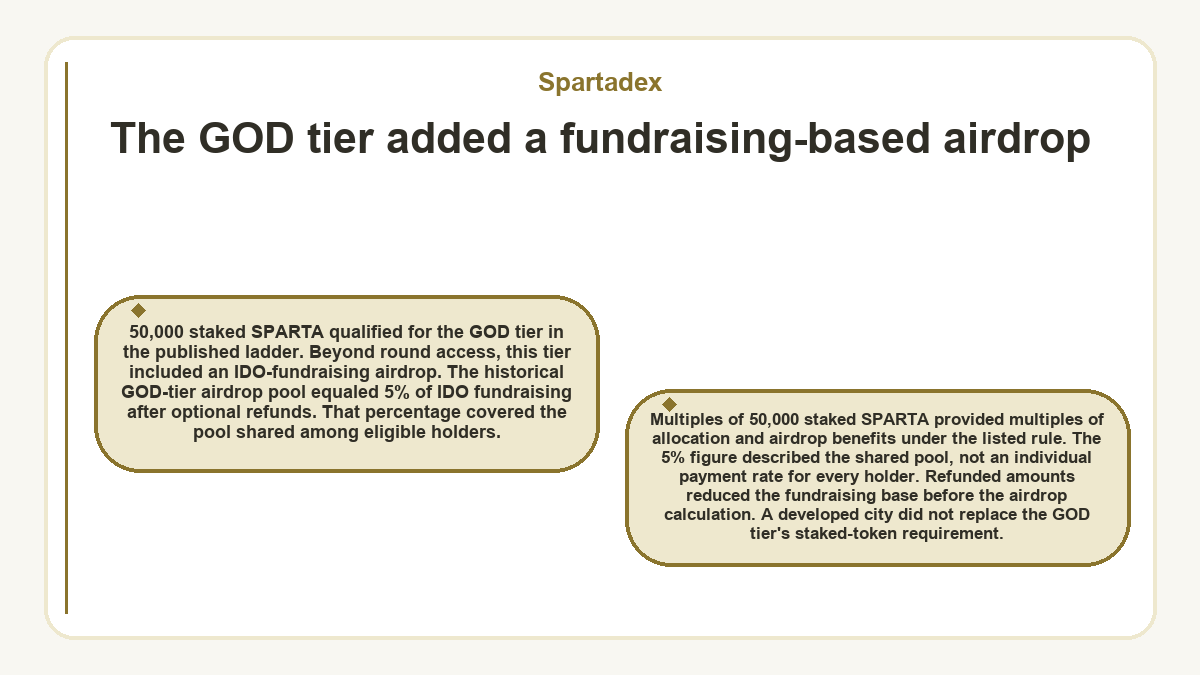
50,000 staked SPARTA qualified for the GOD tier in the published ladder. Beyond round access, this tier included an IDO-fundraising airdrop. The historical GOD-tier airdrop pool equaled 5% of IDO fundraising after optional refunds. That percentage covered the pool shared among eligible holders. Multiples of 50,000 staked SPARTA provided multiples of allocation and airdrop benefits under the listed rule. The 5% figure described the shared pool, not an individual payment rate for every holder. Refunded amounts reduced the fundraising base before the airdrop calculation. A developed city did not replace the GOD tier's staked-token requirement.
Separate staking and Senate requirements
The published launchpad tiers set staked SPARTA thresholds without listing a minimum Senate level. Pursuing higher Senate levels introduced the game's liquidity, experience, and building requirements. Staking and city development supported different launchpad benefits, so meeting a tier threshold alone did not establish a particular Senate bonus.
Useful questions about Spartadex
-
Could a purchased Polis NFT preserve progress relevant to Senate benefits?
- The original game design stored city progress in a Polis NFT and allowed the developed city to be sold. A buyer could acquire that progress without rebuilding the city from the start. Single-asset SPARTA staking remained a separate requirement for the token-based tiers; owning the NFT alone did not establish the qualifying staked balance.
-
Did the Senate schedule give private sales the same 50% allocation boost?
- The 50% boost at Senate level 50 applied to SpartaPad IDO allocations in the documented schedule. Single-asset SPARTA staking also supported eligibility for private sales, but the Senate schedule did not establish an equivalent private-sale boost. Eligibility for those sales and the listed IDO allocation milestones described separate benefits.
-
What role did SPARTA governance have in choosing launchpad offerings?
- Staked SPARTA holders could vote on conducting specific IDOs as part of protocol governance. Each staked token carried the same voting power. That right concerned selecting offerings; the Senate level schedule addressed a participant's allocation. A governance vote itself did not reserve an allocation in the selected sale.
-
How did the GOD airdrop differ from staking Real Yield?
- The GOD-tier airdrop design used a share of IDO fundraising after optional refunds, while Real Yield referred to staking income from exchange revenue. The staking description included swap fees, micropayments, and other fees among those revenue sources. Those were different payment bases, so the GOD tier's 5% fundraising figure was not a general staking return.
-
Would partner-token Dual Rewards count toward a SPARTA staking tier?
- A launchpad tier required staked SPARTA, whereas Dual Rewards could use a participating project's token. The historical LP rules sent 100% of those dual reward tokens to the claimant's wallet. Receiving that partner asset did not itself add SPARTA to single-asset staking or satisfy a SPARTA-denominated tier threshold.
-
Were the Senate milestone percentages cumulative?
- The launchpad schedule assigned a separate boost to each listed milestone, ending at 50% for level 50. It did not instruct participants to add the percentages from earlier milestones. The cumulative APR column in the experience schedule concerned LP yield, a different measure from the IDO allocation bonus.
-
Did the proposed leaderboard use the same reward calculation as IDO allocation boosts?
- The March 4, 2024 LTIPP proposal described a separate points-based leaderboard spanning game progress, liquidity, trading volume, and SPARTA staking. Senate allocation boosts were level-based launchpad benefits. The proposal's competition rewards therefore did not use the listed IDO allocation percentage as a universal reward rate.